
How To Paint A Hellebore Part 1 Read More »
UncategorizedUncategorized
I landed my first Art Show!
I quite often visit a local art cafe and one day I was lucky enough to be asked to display some of my art work!
I’ve never displayed any of my art work physically anywhere before, so this was huge for me!
The place itself is off of the beaten path and it is normal for artists to not sell anything, however it didn’t dampen my spirits.

Above: A selection of my paintings at the art café.

The cafe is ran by a lovely women called Emma who is also an artist herself, so I knew I was in good hands. It’s a really inclusive place of lots of artists and different styles & mediums.
My work was on display for 2 weeks.
The Process
I didn’t have too long to prepare. I was invited to display my work back in February with the display going up for 2 weeks at the beginning of April.
So work quickly began on preparing and selecting the art work that I was going to display.
I started flicking through my folio of completed work I had done over the years. I often feel attached to many of my pieces as I paint for myself rather than a potential buyer in mind. This was tricky. I selected some pieces that I wouldn’t be too upset if I had to say goodbye to. Do other artists have this issue?
I wanted to show at least 8 pieces of art work and I had only managed to select 6 pieces that I had already done. Dilemma!
There was a piece I was half way through of a Hellebore which I knew I could knuckle down and finish ready for the exhibit.
While frame shopping I found some nice metal green frames and felt a yearning for something leafy. I managed to do a illustration of my Monstera plant too just in time. This gave me 8 pieces for the show.
Extras
Now I’m not clueless when it comes to selling yourself. Being predominantly online I am no stranger to the world of self promotion and having to fight to have your voice heard.
Knowing this, I wanted to give this show all I could. I put together some art prints that could also be sold. Let’s face it, we live in tough times and most countries are finding inflation and hard financial times. Not everyone is going to have the budget for original art, however they may impulse buy a print. It was worth a try, right?

Conclusion
So my show as of today has come to the end. I’m waiting to head back to claim any (probably all) pieces that didn’t sell.
Am I disappointed? No, I don’t think so.
I knew what I was potentially getting in for. While I was hopeful that I would sell some prints I knew it was unlikely that I would shift any original paintings.
Having this foresight was actually good for me to have as I was able to focus on delivering to have a good exhibit rather than worrying about sales. I was also able to think “what can I gain from this?”
There are many lessons to learn and this was one of them. At the end of the day, whether I sold or I didn’t I won some experience. My foot has been shoved into the door allowing myself to wiggle my way in. I now have an entry on my artist CV/Resume that I can use to launch myself with into other exhibitions of which I’m already trying to do.
I had a great time and a lot of fun putting together this one and it’s something I’d love to continue doing. Emma was a fantastic host and I really enjoyed the experience. It was so surreal seeing my work on someone else’s wall. It made me feel like a real artist. Hand on heart I would do it all again and would recommend anyone else debating whether they should take the plunge.
If anyone is interested in any of the prints or paintings (framed or unframed) please get in touch as I’m still looking to sell them to a loving home for others to enjoy.
My First Art Exhibition Read More »
UncategorizedMy First Art Exhibition
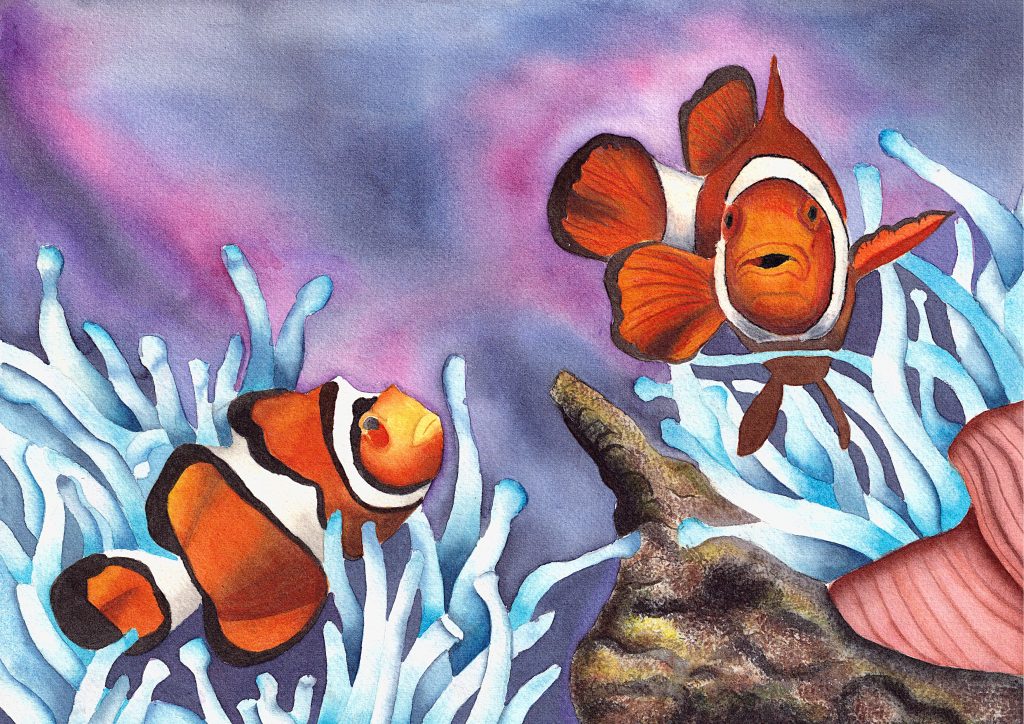
Circus - Watercolour Clownfish
I’m so excited to reveal my latest piece!
This is Circus. Painted on Saunders cold-pressed 300gsm paper using artist grade watercolours.
This painting started life back in late 2021 as a sketch. After doing a test piece and forgetting about the whole thing for a few months I finally started painting it this year.
I mostly paint botanical subjects so when something comes a long that is different it’s opens up some many things. I feel excited & refreshed starting something completely new, but I also feel nervous as it is new ground to cover. I was most nervous to do the background. Backgrounds can be so tricky! It’s finding the balance between detailed but not too detailed. Busy but not too busy. You have to be careful not to draw too much focus from the main subject of the piece.
I had zero idea what I was going to do with the sea in the piece. I was conscious that I didn’t want to go too dark as it would have a huge impact on the mood of the painting. After looking up some clownfish I saw many pictures had a purple like haze in the background.
I equally found the large rock a challenge too. Rocky textures can be tricky to get right. I started off with washes before realising that I could use a stippling technique to achieve the texture much more easily.
In the end I really enjoyed breaking free from my usual subject of botanical. I also like how this turned out. It’s fun and different. Might consider running some limited prints of this one.
I hope you enjoyed coming to see the “Circus”
Circus – Watercolour Clownfish | New Art Work Read More »
UncategorizedCircus – Watercolour Clownfish | New Art Work
I painted my largest painting
I’ve been painting botanical subjects for a few years now and not to sound over confident but I’m fairly comfortable with them. They don’t phase me like they used to!
Time for a challenge. I challenged myself to paint a larger painting. The largest I’ve done so far is 1/4 Imperial sheet, which is about A3. Not wanting to push too far I decided to go for a 1/2 Imperial sheet (A2)!
This was daunting. I was nervous. Was the paper going to fit on my desk? How do I go about planning it? What if I ruin it? Could I really do this?
I breathed and tried to be calm and think about this rationally. I started as I would any major piece of art – a good sketch. I’ve learnt and re-learnt many times now that a bad sketch sets you up for failure. I find it’s best not to rush this and to take enough time to make sure I’m happy with it. I did the sketch digitally then I had to cut it up into 4 pieces so that I could print it. Harder than it sounds!
Hard Part Done?
Not even close. Once I had managed to print this out I had to transfer it to my paper using an A4 light box. Looking back this was probably the easiest part of the process.
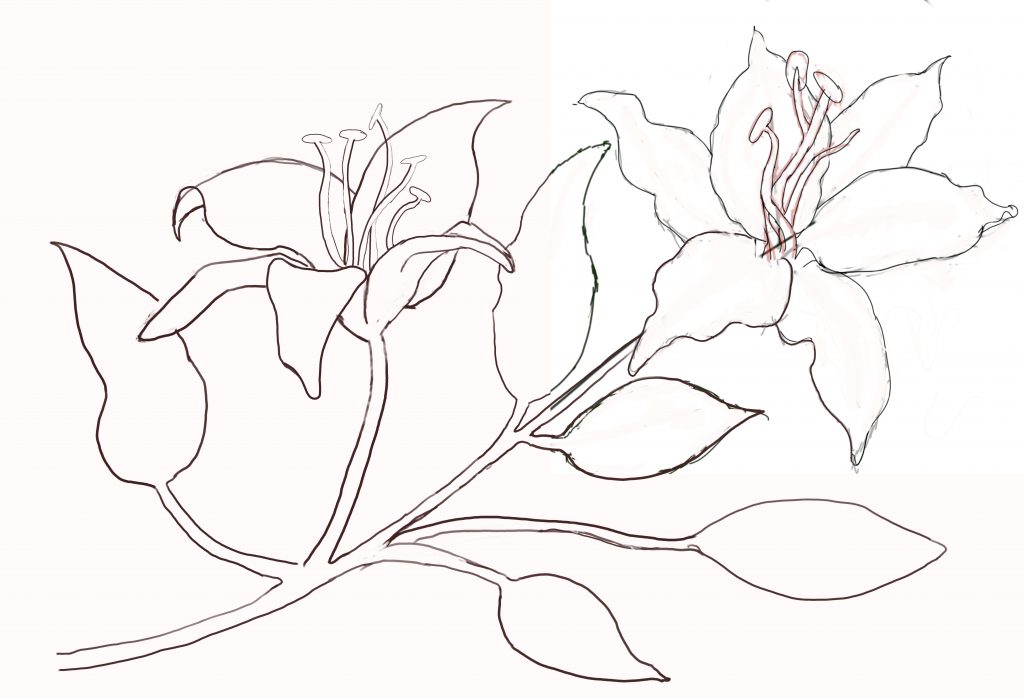
Preparation
Another key step on the path to ensure the painting is as smooth as possible. I erased any really dark lines that had been transfer along with any unsightly marks or smudges. I then masked off the stamens of the flowers as I’m clumsy and did not want them to have any blue transfer.
While the masking fluid was drying I set up everything else. My watercolour palette well stocked with all the colours I needed, water jars for rinsing and painting, any brushes I may need, kitchen roll for dabbing and cleaning and then finally making sure I had my reference images to hand.
I was ready.
The first wash was the most daunting. Once I had the first splash of colour down I felt myself start to relax – I can do this!
With any big or detailed painting I always recommend going slow. Lots of light layers. If you mess anything up it’s easier to fix. Before I knew it the painting was starting to take shape.
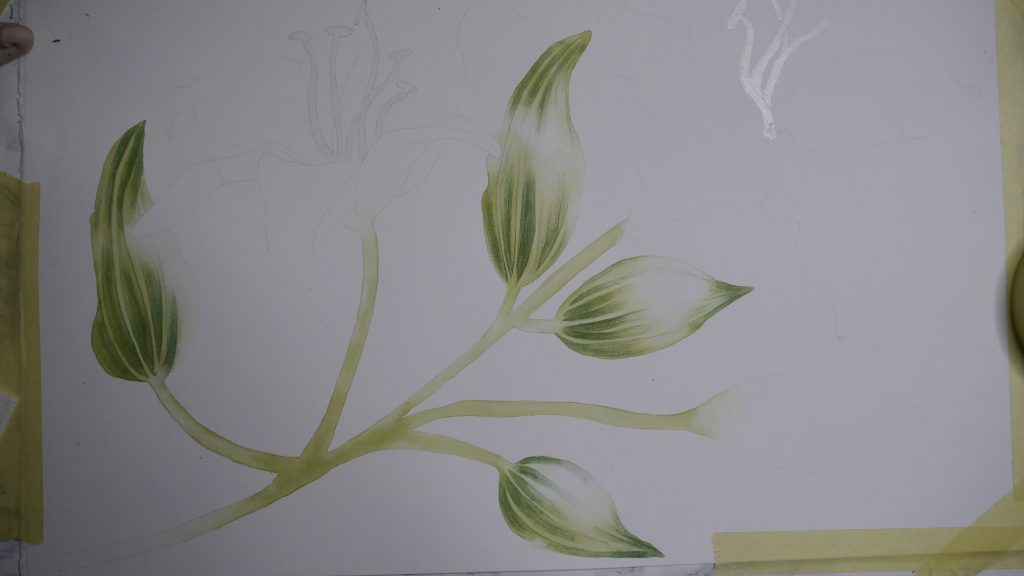
Feeling Blue?
I added my first layers of beautiful blue paint. I love the colour blue. This was definitely going to be the colour I use for these lilies.
Once the washes were done with out came the splayed bristles for some dry brushing. For those unfamiliar with the term, dry brushing is the technique of gently splaying the bristles of your brush and using a drier mix of paint to dust onto the paper. This creates fine lines and textures that can resemble veins, shading and fur. It can be tricky, to much paint and there won’t be any fine lines just blobs. Too little paint and the lines will be too dramatic. There is also a danger of over doing. Some botanical artists do this and in my personal opinion it stops the painting look like it was done with watercolours.
At this stage I remove the masking fluid and paint the stamens. I also tidy the painting up by using some thin washes of paint to add depth and to blend in some of the dry brush. I feel that this helps make the dry brushing look like it is part of the petal/leaf instead of just sitting on top.
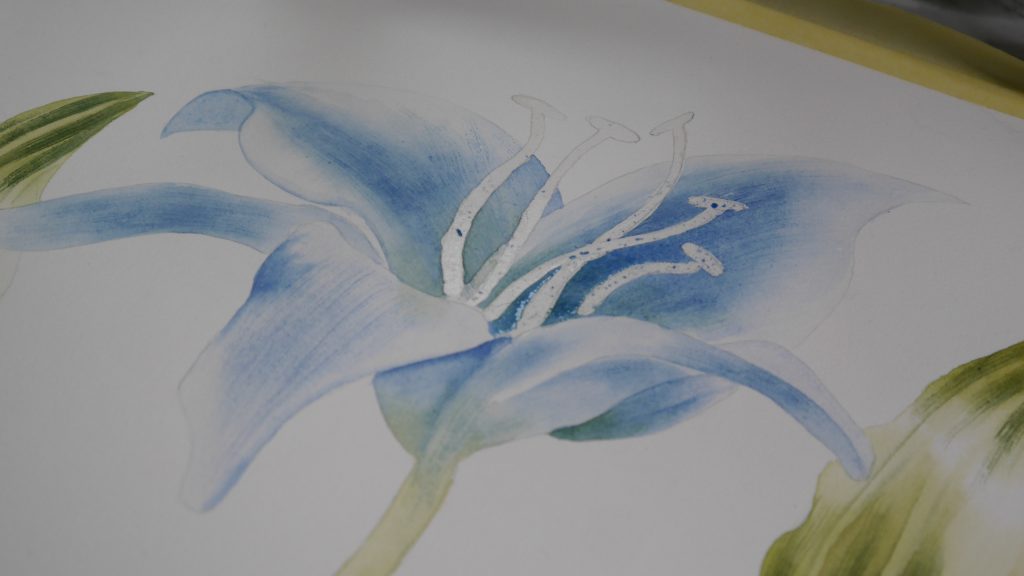
Once I’m happy with the paint and how it looks over all I pull out the coloured pencils. I use them to add extra textures and a little more depth to the painting. I use them sparingly, remember this a piece done with watercolour paint, not pencils. I also use the pencils in some tight corners that are near impossible to do with a brush.
And that’s it. Done!
After all the worry the hard work has paid of and the painting is finished. I have a video showing some of the progress.
I was super happy with how this painting turned out. The colours were good and the paint felt complete.
You can also see more in progress shots over on my patreon page here.
Sign up to my newsletter by heading to the homepage.
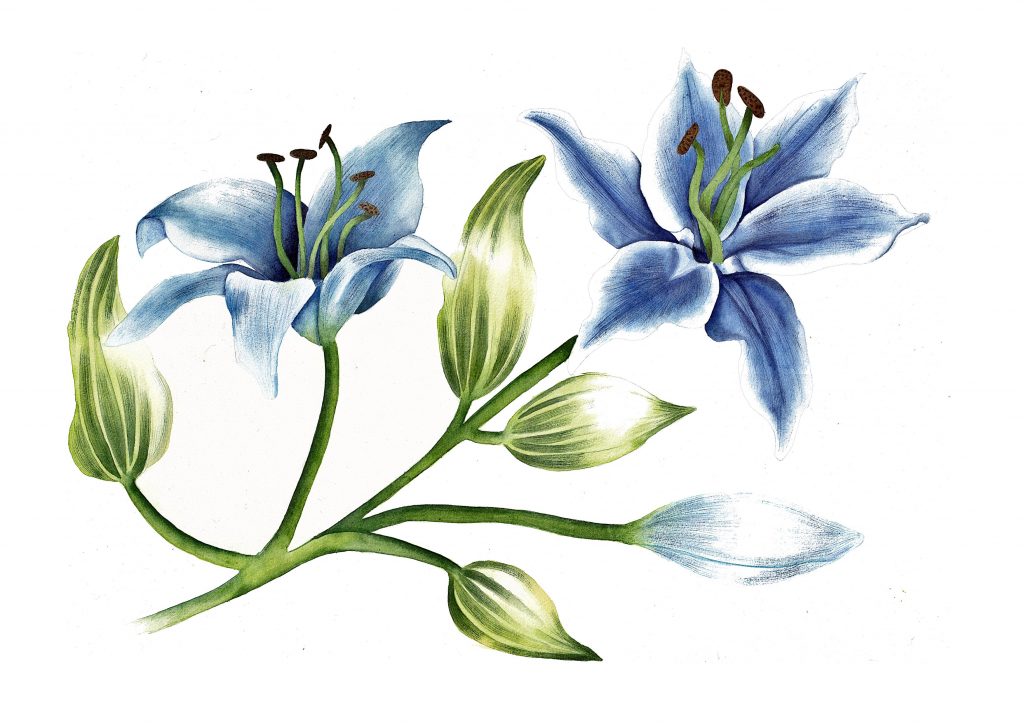
Go Big or Go Home
Are Handmade Watercolours Worth It?
Anyone who has seen handmade watercolour paints will have the same questions going around their head. Are they worth it? What are they? What’s the big deal? Aren’t they expensive?
These questions are completely normal, we all think like this when it comes to spending our hard earned cash and buying handmade watercolor paints aren’t any different.
So what’s the deal?
What are handmade watercolours?
So let’s first start off by defining what handmade colours are as many people don’t really know even after buying them!
Handmade watercolours (or any paint) are exactly what is says on the tin. Paint that is made by hand. Pigment and paint binder are mixed and mulled together using a paint muller. You can find a little more on this here.
Personally I only consider paints to have the handmade label if they have been mixed and mulled by hand. I say this because there are a fair few companies out there claiming to be handmade when actually they are artisan. You can have handmade paints that are artisan but artisan paints aren’t necessarily handmade. Something to keep in mind.
Handmade paints take some work as it requires some effort to grind some pigments down by hand. Using machinery is cheating!
Are handmade paints worth it?
So now we have defined what handmade paints are and how they come into existence we now stage the question – are they worth it?
It depends on who you are and what you’re looking for. If you aren’t looking for unique pigments, artist quality paints, paints with personality or looking to support a small business then handmade paints probably aren’t worth it for you. But! I’m going to try and change your mind!
Most handmade paints are artist quality so if you’re serious about your paints you can buy knowing that you can receive the high quality art materials that your art needs. You can also find a range of unique, quirky and discontinued pigments that you can’t get from a commercial company.
Want to paint with rare gemstones such as Lapis Lazuli? Discontinued pigments like Manganese Blue Genuine? Use ancient pigments from long ago that have now been made obsolete? Well I have some good news – you can potentially find all of the above from a handmade maker. Some pigments are very expensive or are only available in small quantities. This makes them unavailable to large commercial companies but perfect for the handmade maker.
Handmade paints are handmade. Yes I’ve said it multiple times in this article but they are handmade by a person. Yes a real person. A person who is most likely an artist who likes to be creative, quirky and unique. They can channel this into their paints. All paints whether commercial or handmade have their own characteristics. Just like the super honey based formula of Sennelier watercolours handmade paints can have their own quirks and behaviours which can be influenced by the maker. Now you can’t get that from a corporate machine!
On top of some added flare supporting a handmade maker usually means it’s a one person show. Got a question or some feedback? You won’t be contacting some admin team based in a far away land who won’t ever speak to the monkey behind the wheel. Instead contact will often be with the maker themselves! Direct contact has it’s benefits as the maker will be the most knowledgeable person about their product. This is can be really helpful if you have a specific question.
And if that isn’t enough you will also get that feel good boost from supporting a small business.
Are handmade watercolours expensive?
How expensive are handmade watercolours? Are they too expensive?
Fair questions.
Pricing can vary maker to maker, what pigments they offer and which country that they live in.
If they are based in a country with a high cost of living, expensive shipping and offer the rarest and most sort after pigments then this is going to reflect in their prices. Don’t let this put you off some of their expenses are out of their control.
I have had a couple of people buy my colours for a rare colour and give my brand in its entirety a review to only brand my paints as expensive and “You can get this colour from such a such a company for less”. This is a clear example why I’m writing this article! As mentioned above a lot of work goes into making paints by hand. Paints from a handmade maker shouldn’t be compared to bigger corporate companies for this reason. Yes handmade paints are not always the affordable option but that is not their intention.
Handmade paints take a lot of hard work and dedication. This makes them special as they are made with a lot of love and care.
I hope this article has helped you see through the eyes of a paint maker a little more and might consider giving some handmade paints a go.
If you’d like to learn more about the process you can find a video here.

Are Handmade Watercolours Worth It? Read More »
UncategorizedAre Handmade Watercolours Worth It?
What Does A Botanical Artist Do?
What is a botanical artist?
I thought that I would start off with answering a very vague and very broad question. But perhaps it is one that many often ask? Heck even I question this sometimes!
In short a Botanical Artist is an artist who paints plants – that’s it, in a nutshell.
Well okay, that might be the quick & basic answer but there is a lot more to it than just someone who like to paint pretty flowers. To keep things on topic and relevant I’m going to be specifically talking about watercolour as the medium of choice.
What job does a botanical artist do?
When I started using watercolours to paint botanical subjects I never gave much thought into what this could be used for in the big wide world of art as a career. There is a whole range of things that fall under the umbrella of botanical art.
There is of course the very obvious one which is usually what starts people of in the subject of painting plants. Painting pretty flowers and expanding on a love of flowers & plants is what get many interested in the subject. Botanicals are also a forgiving subject compared to some such as portraits or landscapes so it is often an easier start for those who are starting out with watercolours. There is nothing wrong with this at all! if you’re content making nice art work and selling feel no shame. Many well known artists do this such as Anna Mason & Billy Showell who are both renowned for their amazing botanical pieces. But perhaps who want more? Or are you just curious? Is this fully sustainable as a career just painting pretty flowers?
What artist draws plants?
So yes there is more to the botanical art field than just drawing and painting please images. Taking it up a notch there is scientific botanical art. This is pretty close to what I just mentioned but it takes it to a different level. Scientific illustration is painting pretty flowers & plants BUT you focus less on the pretty and more on the accuracy. With scientific study it is more important that things match the real world accurately. Paintings need to be done to scale, either life size or scaled down but that have to be correct.
With my botanical pieces I don’t aim to be scientific, it doesn’t matter to me personally if my leaves are not in proportion to the plant or if certain parts of the plant are incorrect.
This doesn’t apply for scientific illustration as we are moving on from just pretty pictures. They have to be correct. These images are used for information books, scientific studies and education. Yes that rainbow, multi-coloured rose is stunning, is it realistic? No? Then it is not suitable for this particular topic. Don’t feel bad if like me you just want a nice painting, unless you want it to be scientific it feel free to go wild.
Commercial Flowers?
Commercial. This is often a word that artists like to stay away from. I don’t agree, you shouldn’t have to feel guilty for wanting to sell your art or go more commercial.
Commercial illustration steps away from the art aspect a little bit and walks towards graphics & marketing. It is important to remember that is still art!
Personally I feel commercial botanicals are overlooked. This is due to it being right in our faces so we don’t notice or it’s because of some art snobbery. Commercial botanical plays a big part in the world. Don’t believe me? Next time you go out to your local supermarket try this – take a look and see how many flowers, plants, fruit or veg illustration you see. You’ll be surprised at how much you find. Stuck? Okay I’ll help you out, here is what you can find botanical illustration on:
– Jams/jellies
-Honey
-Fruit & Veg labels
-Shampoo
-Shower Gels
-Cosmetics
-Laundry Detergent
-Homeware
-Other food packets such as those energy bars.
The above is often over looked and forgotten about. But all of these illustrations, whichever medium they have been done in is botanical art. Someone has been paid to design, draw and colour these. Just because it isn’t traditional or pretty it doesn’t invalidate it as botanical art.
The takeaway
These are just the main areas of botanical illustration. I wanted to share some of them as I feel it’s really easy to confine “botanical art” to artists like Billy Showell and with only having the purpose of it being nice to look at.
There are many areas of botanicals that you get into. That being said don’t feel guilty or pressured to do something that you don’t want. Want to be a commercial artist working digitally with basic shapes and patterns? This fine. It’s also fine if you only ever want to create pretty pictures.
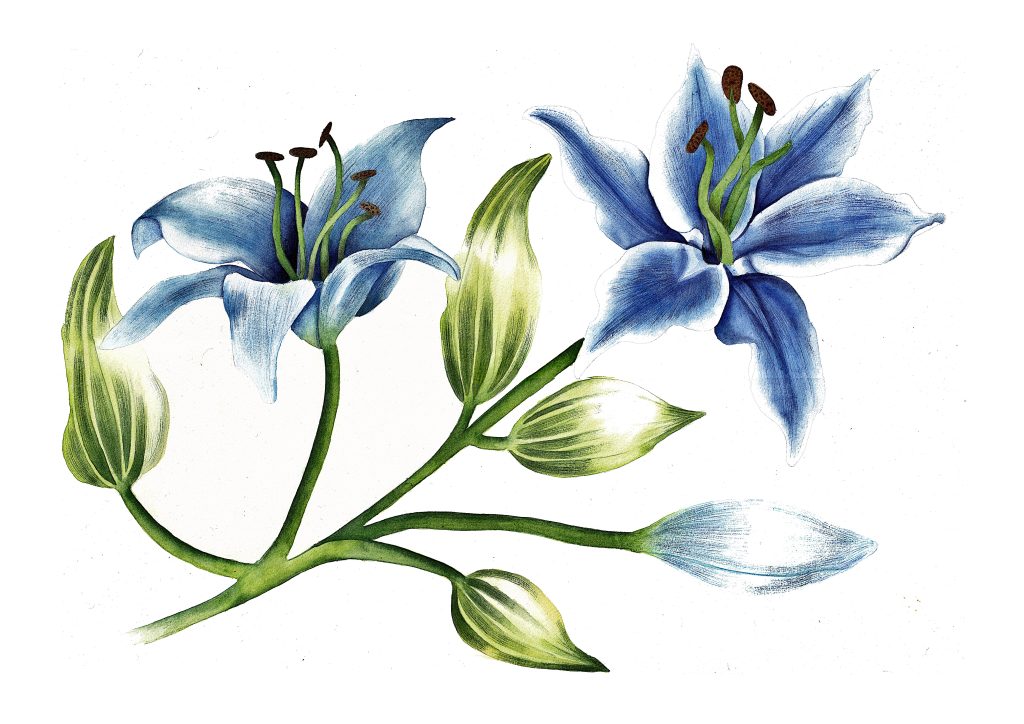
I guess my point is no matter what style or goal you’re going for, if it’s plant based, it’s botanical art. For some examples of botanical art, check out my portfolio.
What Is A Botanical Artist Read More »
Uncategorized